
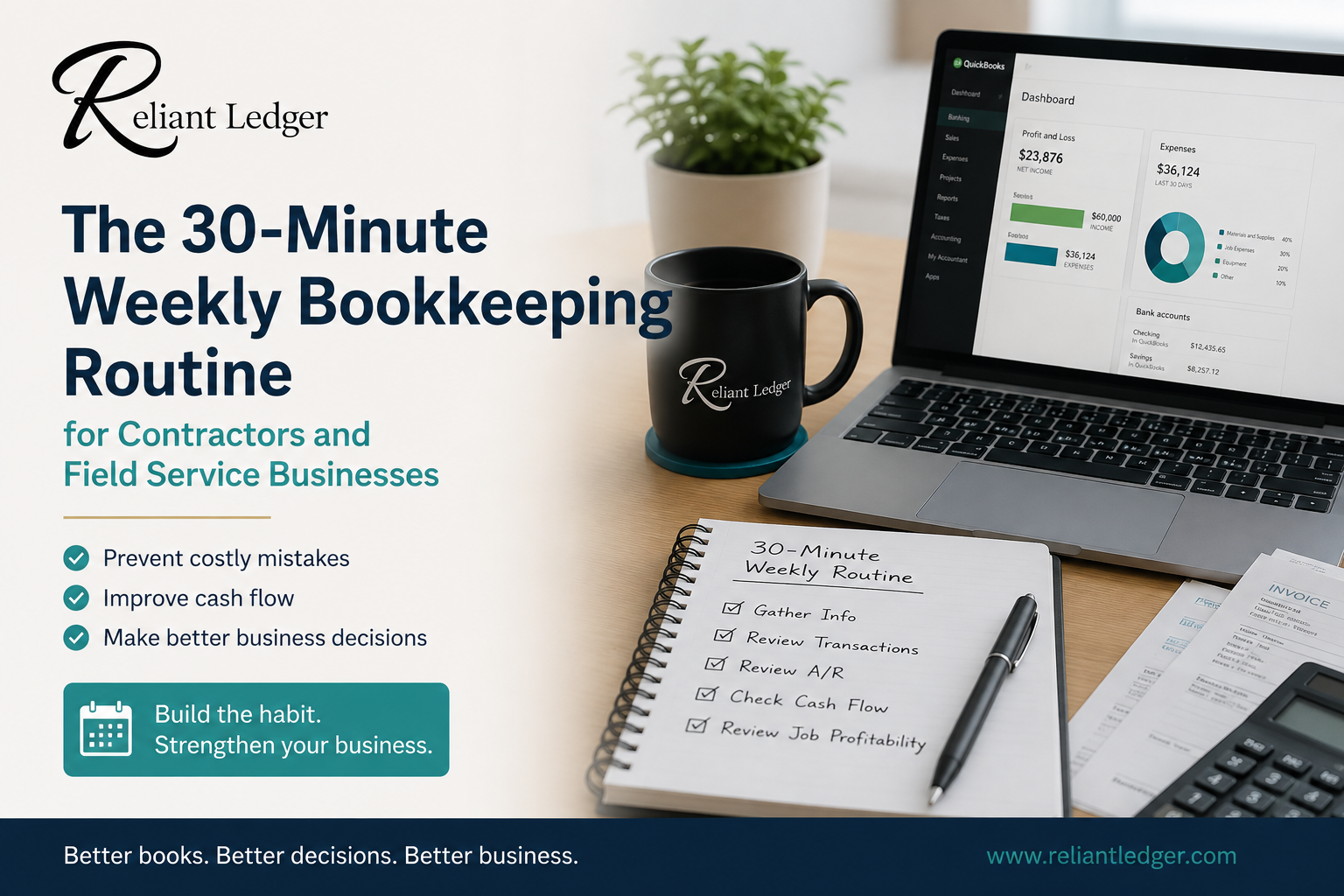
The 30-Minute Weekly Bookkeeping Routine for Contractors and Field Service Businesses
Learn a simple 30-minute weekly bookkeeping routine designed for contractors and field service businesses. Improve cash flow, stay tax-ready, and keep your books organized with easy weekly habits.
Service Industry Insights
For many contractors and field service business owners, bookkeeping tends to fall into one of two categories:
It gets done at tax time.
It gets done when there's a problem.
Neither approach works very well.
When bookkeeping gets pushed aside for months, it becomes overwhelming. Receipts pile up. Transactions go uncategorized. Bank balances become questionable. Tax season becomes stressful.
The good news is that maintaining clean books doesn't require hours every week.
In fact, many small business owners can stay on top of their finances with a simple 30-minute weekly bookkeeping routine.
A little consistency each week can prevent major cleanup projects later.
Why Weekly Is Better Than Monthly
Many business owners wait until the end of the month to review their finances.
The problem is that by then:
Missing receipts are harder to find
Billing delays have already impacted cash flow
Bank errors may go unnoticed
Customer payments may already be overdue
A weekly routine keeps small issues from becoming large problems.
Think of it like preventative maintenance for your business finances.
The First 5 Minutes: Gather Your Financial Information
Start by collecting:
Bank account information
Credit card transactions
Receipts
Vendor invoices
Customer payments received
If you're using QuickBooks Online, much of this information may already be imported through bank feeds.
The goal is simply to make sure everything is available before you begin.
The Next 10 Minutes: Review and Categorize Transactions
Now review the week's activity.
Ask:
Is every transaction categorized correctly?
Were any personal expenses accidentally charged to the business?
Are all customer payments recorded?
Are there any duplicate transactions?
This step helps ensure your Profit & Loss report remains accurate throughout the year.
Small mistakes are easy to fix now.
They're much harder to fix six months from now.
The Next 5 Minutes: Review Accounts Receivable
Money owed to your business deserves attention every week.
Review:
Outstanding invoices
Overdue balances
Recent customer payments
Ask yourself:
Has every completed job been invoiced?
Are any invoices becoming overdue?
Do customers need payment reminders?
One of the easiest ways to improve cash flow is simply following up on unpaid invoices consistently.
The Next 5 Minutes: Check Cash Flow
You don't need a complicated forecast.
Simply review:
Current bank balance
Upcoming payroll
Vendor payments due
Large expenses expected soon
This quick review can help identify cash shortages before they become emergencies.
Many business owners discover that a 5-minute review saves hours of financial stress later.
The Final 5 Minutes: Review Job Profitability
If you're tracking jobs, spend a few minutes reviewing:
Labor costs
Material costs
Subcontractor expenses
Progress toward completion
Ask:
Are jobs staying within budget?
Are any projects losing money?
Do pricing adjustments need to be made?
The sooner you identify profitability problems, the easier they are to correct.
What Happens When You Skip This Routine?
When bookkeeping gets postponed:
Invoices go unsent
Customer payments slow down
Receipts disappear
Tax preparation becomes stressful
Financial reports become unreliable
Many bookkeeping cleanup projects begin with a simple problem:
"I got busy and stopped looking at my books."
A Weekly Habit That Builds Better Businesses
Successful contractors don't necessarily spend more time on bookkeeping.
They spend time consistently.
Thirty minutes each week can help you:
Maintain clean books
Improve cash flow
Stay tax-ready
Understand profitability
Make better business decisions
Consistency beats catch-up every time.
The Bottom Line
Bookkeeping doesn't have to take over your life.
A simple 30-minute weekly routine can help you stay organized, reduce financial stress, and maintain better visibility into your business.
Small habits create big results.
Better books. Better decisions. Better business.

Why Great Months Still Feel Broke: Understanding Cash Flow for Contractors and Field Service Businesses
A full schedule doesn't always mean healthy finances. Discover why contractors and field service businesses can be profitable on paper yet struggle with cash flow—and what to do about it.
Service Industry Insights
Have you ever looked at your schedule and thought:
"We've been busy all month. Why does it still feel like there's never enough cash in the bank?"
If you're a contractor or field service business owner, you're not alone.
Many business owners assume that a full schedule automatically means healthy finances. Unfortunately, that's not always true. A company can have strong sales, a full pipeline of work, and still struggle to pay bills on time.
The reason often comes down to one critical concept: cash flow.
Understanding cash flow can help you reduce financial stress, make better decisions, and build a stronger business.
What Is Cash Flow?
Simply put, cash flow is the movement of money into and out of your business. Positive cash flow means that over a given period, more cash is coming into the business than leaving it. Negative cash flow means expenses are leaving your business faster than payments are arriving.
For contractors and field service businesses, cash flow can be especially challenging because expenses often occur long before customer payments arrive.
You may need to pay for:
Materials
Labor
Fuel
Equipment
Insurance
Subcontractors
Weeks before receiving payment from the customer.
Revenue Doesn't Equal Cash
One of the most common bookkeeping misunderstandings is assuming revenue equals cash.
The timing between completing work and receiving payment can vary significantly depending on your business model.
A field service company may complete a job and invoice the same day.
A contractor may operate on deposits, progress billing, milestone payments, or retainage agreements.
Regardless of the billing method, cash flow challenges arise whenever expenses leave the business faster than payments arrive.
This is why profitable businesses can still experience cash shortages.
Profit and Cash Flow Are Not the Same Thing
One of the most important financial concepts for business owners to understand is the difference between profit and cash flow.
Profit measures whether your revenue exceeds your expenses.
Cash flow measures whether cash is available when bills come due.
A business can be profitable on paper while still struggling to meet payroll, purchase materials, or pay vendors if customer payments have not yet been collected.
Understanding both profit and cash flow helps business owners make more informed financial decisions.
The Three Biggest Cash Flow Killers
1. Delays Between Work and Payment
One of the biggest challenges for both contractors and field service businesses is the time between completing work and receiving payment.
For field service companies, delays often occur when invoices are not sent promptly after a job is completed. Contractors face a different challenge, managing deposits, progress billing, retainage, and collection timelines throughout a project.
Regardless of the billing method, the longer cash is tied up, the greater the strain on working capital. Field service businesses can often improve cash flow by making invoicing part of the job completion process—a concept I discuss in The Driveway Rule: The Ultimate Cash Flow Hack. Contractors can achieve similar results through clear payment terms, timely progress billing, and proactive collection practices.
2. Slow Customer Payments
Even when invoices are sent promptly or billing milestones are met, some customers take longer to pay than expected.
Contractors often experience payment delays due to:
Approval processes
Progress billing schedules
Retainage
Administrative delays
Field service businesses may face delays when customers overlook invoices or postpone payment.
The longer payments are delayed, the more pressure is placed on working capital.
3. Unexpected Expenses
Every contractor and service business owner has experienced surprise costs:
Equipment repairs
Vehicle maintenance
Material price increases
Project delays
Weather-related disruptions
Without adequate cash reserves, even a profitable month can become financially stressful.
Why Strong Sales Don't Always Mean Healthy Cash Flow
Sales measure activity. Cash flow measures liquidity.
A business can have strong sales and still experience financial stress if customer payments are delayed or expenses exceed available cash.
Healthy cash flow allows you to:
Pay employees on time
Purchase materials when needed
Take advantage of growth opportunities
Reduce reliance on credit
Maintain greater financial stability and confidence
Businesses that actively manage cash flow are generally better positioned to handle slow periods and unexpected challenges.
Five Practical Ways to Improve Cash Flow
1. Reduce the Time Between Work and Payment
Field service businesses may benefit from invoicing immediately after completing a job.
Contractors may improve cash flow by using deposits, progress billing, milestone payments, and clearly defined payment terms.
The goal is to reduce unnecessary delays between performing the work and receiving payment.
2. Collect Deposits When Appropriate
For larger projects, upfront deposits can help cover material costs and reduce financial risk.
Clear payment schedules can also improve predictability and help maintain healthy working capital throughout a project.
3. Forecast Cash Flow
Spend a few minutes each week reviewing:
Upcoming payroll
Vendor payments
Expected customer payments
Regular forecasting can help identify potential shortages before they become emergencies.
4. Build a Cash Reserve
Building a cash reserve—even one month's worth of operating expenses—can help provide additional stability during slower periods or unexpected disruptions.
While every business is different, having cash set aside can reduce stress and provide flexibility when challenges arise.
5. Review Job Profitability
Cash flow problems are sometimes profitability problems in disguise.
If jobs are not generating enough profit, cash flow will eventually suffer.
Understanding labor costs, material costs, overhead expenses, and pricing helps ensure that your work contributes to both profitability and healthy cash flow.
The Connection Between Cash Flow and Recurring Revenue
One reason many successful service businesses invest in maintenance agreements and service plans is predictability.
Recurring revenue creates more consistent cash inflows, making it easier to manage expenses and forecast future cash needs.
If you haven't already, I encourage you to read The Field Service Guide to Predictable Recurring Revenue to learn how recurring income can help smooth out the feast-or-famine cycle many service businesses experience.
The Bottom Line
Being busy doesn't automatically mean your cash flow is healthy.
Cash flow improves when you:
Reduce delays between work and payment
Monitor receivables
Forecast regularly
Maintain cash reserves
Understand your numbers
A full schedule is important.
Getting paid for that work in a timely manner—and maintaining sufficient cash to operate your business—is what keeps your company moving forward.
Ready for Better Visibility Into Your Numbers?
At Reliant Ledger, I help contractors and field service businesses maintain clean books, understand their cash flow, and make confident financial decisions.
Better books. Better decisions. Better business.

Simple Bookkeeping Systems for Contractors and Field Service Businesses
Confidence in your business finances doesn’t arrive with a bold entrance or a perfectly organized tax season. It builds quietly, one decision at a time, through systems that support your business day after day. For small business owners, financial clarity is not just a “nice to have.” It is the difference between running your business with confidence and constantly reacting to surprises.
Many entrepreneurs start their businesses because they are passionate about their craft. Contractors want to build. Service professionals want to serve clients. Shop owners want to create a memorable customer experience. Very few people launch a business because they are excited about reconciling bank accounts or organizing receipts.
That’s completely normal.
The problem is that bookkeeping often gets pushed aside until it becomes urgent. A business owner looks up one day and realizes they are months behind, unsure of their cash flow, overwhelmed during tax season, and making decisions without reliable numbers.
The good news is this: strong bookkeeping systems are not built overnight. They are built through small, repeatable habits that create momentum over time.
You do not need to become a CPA to gain control of your business finances. You simply need systems that work consistently.
Big goals can feel overwhelming when you are managing operations, employees, customer relationships, and daily responsibilities. But progress rarely comes from giant leaps. Momentum is created through small actions repeated consistently.
You do not need to have all the answers today. You just need to trust the system you are building.
Why Bookkeeping Matters More Than Most Business Owners Realize
Many small business owners view bookkeeping as something they “have to do for taxes.” In reality, bookkeeping affects nearly every decision you make in your business.
Without accurate books:
You cannot clearly see profitability
Cash flow problems appear unexpectedly
Pricing decisions become guesswork
Tax deductions may be missed
Growth becomes difficult to manage
Stress levels increase significantly
With organized books, however, you gain clarity.
You can see which services are profitable. You know when cash is tight before it becomes a crisis. You understand where your money is going and can make decisions based on facts instead of assumptions.
Good bookkeeping also saves time.
How many hours are lost searching for receipts, trying to remember transactions, or sorting through spreadsheets that no longer make sense? For many business owners, financial disorganization quietly steals productive time every single week.
The reality is that bookkeeping is not separate from your business strategy—it supports it.
When your financial systems are organized, you gain the confidence to grow.
The Foundation: Setting Up for Success
Before you can streamline your habits, you need a solid structure underneath them. Setting things up correctly now saves hours of frustration later.
Think of bookkeeping systems like building a house. If the foundation is weak, every future step becomes harder.
Separate Business and Personal Finances
One of the most important steps any small business owner can take is separating business and personal expenses completely.
This means having:
A dedicated business checking account
A dedicated business savings account
A business credit card used only for business purchases
Mixing personal and business spending creates confusion quickly. Even small personal purchases mixed into business transactions can make bookkeeping far more complicated.
Separate accounts create a clean paper trail. They simplify tax preparation, reduce errors, and make it easier to understand your business performance.
If you are currently using one account for everything, do not feel discouraged. Many business owners start that way. The important thing is making the shift now before the problem grows larger.
Choose the Right Accounting Software
Modern cloud-based accounting software has transformed bookkeeping for small businesses.
Programs like QuickBooks Online and Xero automate many processes that once required hours of manual work. Bank feeds automatically import transactions, reports are generated instantly, and financial data becomes accessible from anywhere.
The right software helps you:
Track income and expenses
Reconcile accounts efficiently
Monitor cash flow
Send invoices
Prepare for taxes
Scale more easily as your business grows
For many small businesses, QuickBooks Online is especially valuable because it integrates with payroll systems, payment processors, and industry-specific apps.
The key is not simply purchasing software—it is setting it up correctly from the beginning.
A poorly structured chart of accounts or inconsistent categorization can create confusion later. Investing time upfront to organize your software properly pays off significantly over time.
Create a Simple Filing System
Bookkeeping becomes stressful when documents are scattered everywhere.
A simple digital filing system can eliminate hours of frustration.
Create folders for:
Receipts
Bank statements
Tax documents
Vendor invoices
Payroll records
Insurance information
Cloud storage platforms like Google Drive or Dropbox make this easy and accessible from anywhere.
The goal is not perfection. The goal is consistency.
When every document has a home, bookkeeping becomes far less overwhelming.
The Maintenance: Turning Intention into Action
Once your systems are in place, consistency becomes the next priority.
Many business owners assume bookkeeping requires huge blocks of uninterrupted time. In reality, small routines are often more effective than marathon bookkeeping sessions every few months.
Action creates clarity.
Instead of waiting for the “perfect moment” that never arrives, focus on manageable habits that keep your books current.
The Daily Scan
One of the simplest habits you can build is the two-minute receipt scan.
Every day, scan receipts into your digital storage system using your phone. Many accounting apps allow direct uploads and receipt capture.
This tiny habit prevents what many business owners know as the “shoe-box effect”—piles of paper receipts that become impossible to sort later.
A daily scan helps:
Reduce lost receipts
Improve expense tracking
Simplify tax deductions
Keep records organized year-round
It may seem small, but small habits prevent major headaches later.
The Weekly Power Hour
Consistency matters more than intensity.
Instead of waiting until month-end or tax season, schedule a dedicated “Weekly Power Hour.”
Spend 30–60 minutes each week:
Reviewing transactions
Categorizing expenses
Matching receipts
Sending invoices
Reviewing unpaid balances
Reconciling accounts
This routine helps you catch errors in real time rather than months later when details are harder to remember.
The Weekly Power Hour also creates awareness.
You begin noticing spending patterns, cash flow trends, and operational issues much sooner. That awareness allows you to make proactive decisions instead of reactive ones.
Build a Repeatable Checklist
Checklists reduce mental clutter.
When bookkeeping tasks live only in your head, they are easier to forget. A repeatable checklist keeps your systems consistent.
Your weekly checklist might include:
Review bank transactions
Upload receipts
Reconcile accounts
Send customer invoices
Follow up on unpaid invoices
Review upcoming bills
Check payroll obligations
Review cash flow
The goal is to create a process you can repeat without reinventing the wheel every week.
Systems reduce stress because they eliminate constant decision-making.
Cash Flow: The Lifeline of a Small Business
Many profitable businesses still struggle because of poor cash flow management.
Cash flow is not simply about how much money your business earns. It is about timing.
You may have outstanding invoices, future projects booked, and strong sales—but if cash is not available when bills are due, stress builds quickly.
Strong bookkeeping systems help you monitor:
Incoming revenue
Outstanding invoices
Recurring expenses
Seasonal trends
Payroll obligations
Tax liabilities
Without accurate numbers, cash flow problems often go unnoticed until they become urgent.
Understand Your Slow Seasons
Every industry has patterns.
Contractors may slow during certain weather seasons. Retail businesses often experience holiday spikes. Service businesses may have predictable fluctuations throughout the year.
When your bookkeeping is current, you can identify these patterns early.
This allows you to:
Build reserves
Plan ahead
Adjust spending
Prepare for slower periods
Planning ahead creates stability.
Invoice Promptly
One of the easiest ways to improve cash flow is invoicing quickly.
Many business owners delay invoicing because they are busy in the field or focused on operations. Unfortunately, delayed invoicing often leads to delayed payment.
Consider adopting a “same-day invoicing” habit whenever possible.
The faster invoices go out:
The faster cash comes in
The fewer invoices get forgotten
The less administrative backlog builds
Consistent systems improve both professionalism and cash flow.
The Hidden Cost of Disorganized Books
Disorganized bookkeeping creates more than frustration. It creates hidden costs throughout the business.
Those costs may include:
Missed deductions
Late fees
Overdraft charges
Duplicate expenses
Tax penalties
Lost productivity
Poor pricing decisions
Perhaps the biggest hidden cost is decision fatigue.
When your numbers are unclear, every decision feels uncertain.
Can you afford to hire?
Should you purchase equipment?
Are your services priced correctly?
Can you comfortably take a vacation?
Without reliable financial data, even simple decisions become stressful.
Clean books create confidence.
The Emotional Side of Bookkeeping
Bookkeeping is not only about numbers. It is also emotional for many business owners.
Financial disorganization often creates guilt, avoidance, or anxiety.
Business owners sometimes delay looking at their books because they fear what they might find. Unfortunately, avoidance usually increases stress rather than reducing it.
The truth is that most bookkeeping problems are fixable.
Even if your books are months behind, progress starts with one step.
You do not have to clean up everything overnight. You simply need to start moving forward consistently.
Small improvements create momentum.
When Growth Creates New Challenges
As your business grows, bookkeeping complexity grows with it.
More customers, more transactions, payroll, subcontractors, inventory, and sales tax requirements all add layers of responsibility.
The systems that worked during startup may no longer work during growth.
This is often the stage where business owners begin feeling stretched thin.
The “Weekly Power Hour” that once felt manageable starts slipping off the calendar. Receipts pile up. Reconciliations fall behind. Financial reports become outdated.
This is not failure. It is often a sign that your business is growing.
Growth requires systems that scale.
When to Consider Outsourced Bookkeeping
At some point, many business owners realize their time is more valuable elsewhere.
Outsourced bookkeeping allows you to maintain financial clarity without personally managing every transaction.
A professional bookkeeper can help:
Reconcile accounts accurately
Maintain clean financial records
Generate reports
Track cash flow
Prepare for taxes
Identify financial trends
Reduce bookkeeping stress
Most importantly, outsourcing gives business owners time back.
Time to focus on:
Customer relationships
Operations
Sales
Team development
Strategic growth
Your role as a business owner should increasingly focus on leadership and decision-making—not chasing receipts at midnight.
Signs It May Be Time to Outsource
You may benefit from outsourced bookkeeping if:
Your books are consistently behind
You avoid reviewing your finances
You are unsure about profitability
Tax season feels overwhelming
You spend weekends catching up on bookkeeping
Cash flow surprises are becoming common
You are losing billable hours to administrative work
Outsourcing does not mean losing control.
In fact, it often increases visibility because your reports become more accurate and current.
Bookkeeping Systems Create Business Confidence
One of the greatest benefits of organized bookkeeping is confidence.
Confidence to:
Make decisions
Invest in growth
Hire employees
Raise prices appropriately
Plan for the future
Navigate uncertainty
Financial clarity changes the way business owners operate.
Instead of constantly reacting, you begin leading proactively.
That shift is powerful.
Accurate Books Tell the Story of Your Business
Your bookkeeping is more than numbers on a report—it is the financial story of your business. Every sale, expense, invoice, and payment paints a picture of how your business is operating and growing.
That story has to be accurate.
Clean, organized bookkeeping allows you to understand where your money is going, how profitable your work truly is, and whether your business is moving in the right direction. When your books are incomplete or unsupported, the picture becomes unclear.
Every dollar spent in your business should be supported by proper documentation. Receipts, invoices, bank records, and payroll reports are not just paperwork—they protect your business, support your tax deductions, and provide confidence in your financial decisions.
Strong bookkeeping systems are built through consistent habits:
Scanning and saving receipts
Reconciling accounts regularly
Reviewing transactions weekly
Keeping supporting documentation organized
Small actions performed consistently create reliable financial records over time.
The goal is not creating a “perfect” system.
The goal is building accurate, scalable bookkeeping systems that support smarter decisions, cleaner financial reporting, and long-term business growth.
Final Thoughts: Small Steps Lead to Big Growth
The road to business growth is rarely smooth. Every entrepreneur faces challenges, uncertainty, and seasons of overwhelm.
But sustainable growth is built through consistent systems—not constant chaos.
Small financial habits may not feel dramatic in the moment, but over time they create something powerful:
Clarity
Confidence
Stability
Scalability
Bookkeeping is not simply about compliance or taxes. It is about understanding your business well enough to lead it effectively.
The systems you build today become the foundation your future business depends on tomorrow.
You do not need to tackle everything at once. Start with one small improvement. Then another. Then another.
Those small steps add up faster than you think.
Building strong financial systems starts with small, consistent habits. Download the FREE Weekly Bookkeeping Checklist to help you stay organized, accurate, and confident in your business finances each week.