
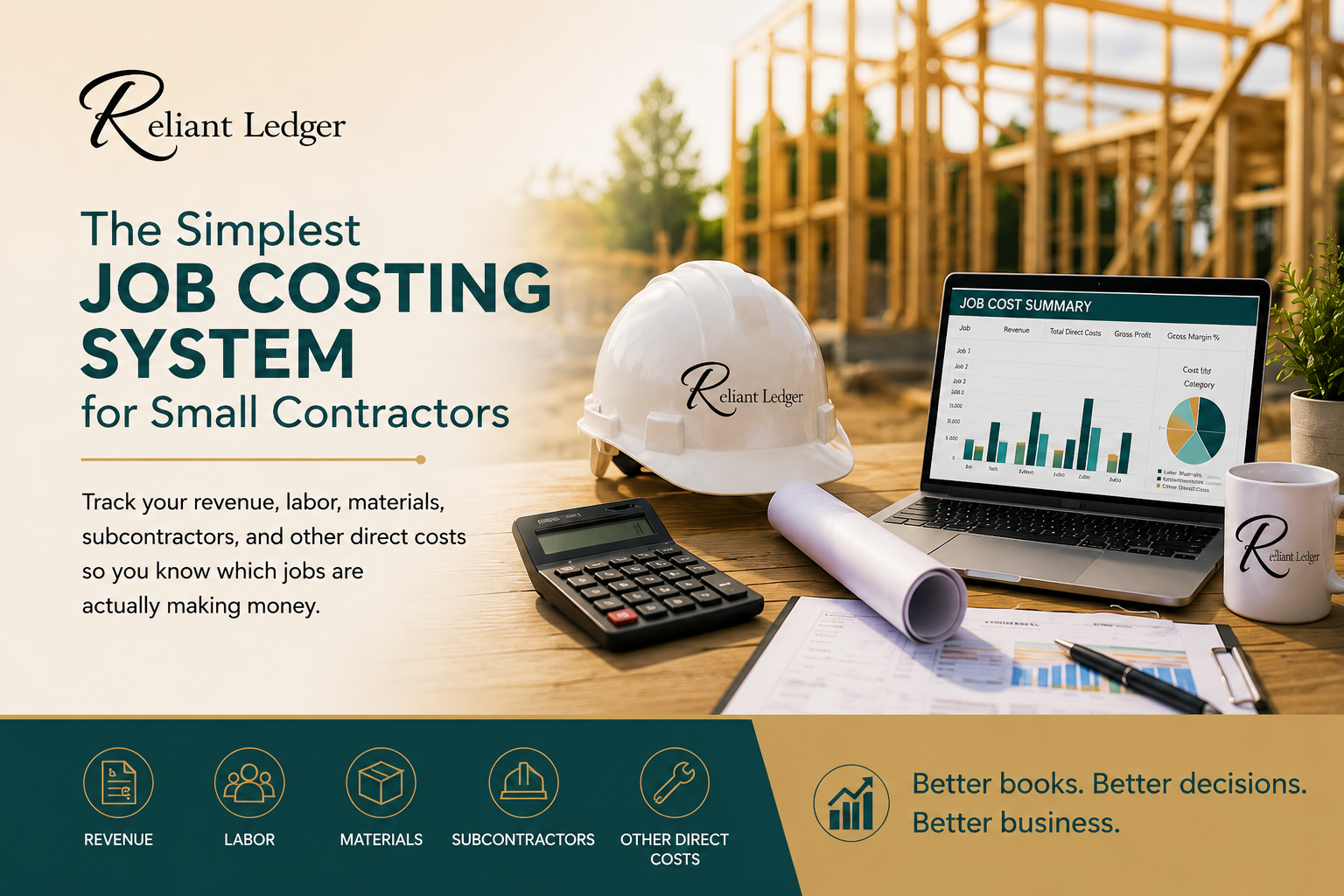
The Simplest Job Costing System for Small Contractors
Service Industry Insights
Many contractors know whether they are busy.
Far fewer know whether they are actually making money on each job.
At the end of the month, the bank account may be lower than expected. The schedule may be full, yet profits seem difficult to find.
The problem often comes down to one thing:
You can't improve what you don't measure.
That's where job costing comes in.
The good news is that job costing doesn't have to be complicated. You don't need expensive software or a full accounting department. A simple system can help you understand which jobs are profitable, which jobs need improvement, and whether your pricing is working.
What Is Job Costing?
Job costing is simply the process of tracking the income and expenses associated with a specific job or project.
For every job, you want to answer one question:
Did this job make money?
To answer that question, you need to compare:
Job Revenue
Labor Costs
Material Costs
Subcontractor Costs
Equipment and Other Direct Costs
The difference between your revenue and direct job costs is your gross profit for that job. Many contractors refer to this as "job profit," but gross profit is the accounting term you'll commonly see on financial reports.
Why Job Costing Matters
Without job costing, most contractors are forced to rely on guesswork.
You may know your company made money last month.
But do you know:
Which jobs were most profitable?
Which jobs lost money?
Whether your pricing is accurate?
Whether material costs are increasing?
Whether labor is taking longer than estimated?
Job costing provides answers.
It helps you make better decisions about pricing, estimating, staffing, and growth.
The Five Numbers Every Contractor Should Track
The simplest job costing system starts with five key categories.
1. Revenue
For a simple job costing system, start by tracking the amount billed (or earned) for the job. More advanced accounting methods may recognize revenue differently, but this approach works well for many small contractors.
Examples:
Service call invoice
Remodel contract
New installation project
Commercial maintenance agreement
Record the amount billed (or earned, depending on how you recognize revenue) for the job.
2. Labor
Labor is often one of the largest job costs.
Include:
Employee wages
Payroll taxes (when practical)
Labor hours worked
For a simple system, start by tracking employee wages and hours worked. As your business grows, consider including payroll taxes, workers' compensation, employee benefits, and other payroll costs to better reflect the true cost of labor.
Example:
Two technicians worked 8 hours each at $25 per hour.
16 hours × $25 = $400
3. Materials
Track materials used specifically for that job.
Examples:
Lumber
Pipe
Electrical supplies
HVAC equipment
Landscaping materials
Always assign material purchases to the appropriate job whenever possible. Materials purchased for general inventory should be assigned to the job when they are actually used, not simply when they are purchased.
4. Subcontractors
Examples:
Electrical subcontractor
Plumbing subcontractor
Drywall contractor
Concrete contractor
Track payments made to outside companies or individuals hired to complete work on a specific job.
5. Other Direct Costs
These are costs that can be traced directly to one specific job but don't fit into labor, materials, or subcontractors.
Examples include:
Equipment rental
Dumpster rental
Permit fees
Disposal fees
Job-specific fuel charges
Specialized tools rented for one project
If the expense exists because of that specific job, it belongs in direct job costs.
A Simple Job Costing Example
Let's say you complete a small HVAC installation.
Revenue:
$8,000
Labor:
$2,500
Materials:
$2,000
Equipment Rental:
$300
Total Direct Costs:
$4,800
Gross Profit:
$3,200
Gross Margin:
$3,200 ÷ $8,000 = 40%
Gross Profit = Revenue − Direct Job Costs
Gross Margin = Gross Profit ÷ Revenue
Gross profit tells you how many dollars the job generated before overhead expenses, while gross margin expresses that amount as a percentage of revenue.
This job generated a 40% gross margin before overhead expenses, meaning 40 cents of every dollar earned remained to cover overhead and contribute to net profit.
Now you have meaningful information you can compare to future jobs.
Don't Forget Overhead
One of the biggest mistakes contractors make is assuming gross profit equals company profit.
It doesn't.
Your business still has expenses that support every job.
Examples include:
Office rent
Insurance
Software subscriptions
Phones
Bookkeeping
Advertising
General vehicle expenses that cannot reasonably be assigned to a specific job
These costs are known as overhead.
A simple job costing system doesn't require you to allocate every overhead expense to every job.
However, you should understand that overhead must ultimately be covered by your gross profit.
This is one reason many contractors underprice their work without realizing it.
The Spreadsheet Method
Many small contractors can start with a simple spreadsheet.
Create columns for:
Job Name
Revenue
Labor Cost
Material Cost
Subcontractor Cost
Other Direct Costs
Total Direct Costs
Gross Profit
Gross Margin %
Update the spreadsheet as jobs are completed.
After several months, patterns begin to emerge.
You'll quickly see which jobs generate the strongest profits.
Reviewing Your Numbers
Job costing is only useful if you review it.
At least once per month, ask:
Which jobs were most profitable?
Which jobs had cost overruns?
Which jobs took longer than expected?
Are material costs increasing?
Are estimates accurate?
Small improvements in estimating, pricing, labor efficiency, or material purchasing can significantly improve profitability over time.
Common Job Costing Mistakes
Not Tracking Labor
Many contractors track materials but forget labor.
Labor is often one of the largest project costs.
Waiting Until Year-End
Job costing works best when reviewed regularly.
Waiting until tax season eliminates the opportunity to correct problems.
Ignoring Small Costs
Equipment rentals, permits, disposal fees, and other direct job costs all affect profitability. Even relatively small expenses can reduce the profit on a job if they aren't tracked.
General vehicle expenses that support the entire business are typically treated as overhead unless they can reasonably be assigned to a specific job.
Small costs add up quickly.
Looking Only at Revenue
Revenue is important.
Profitability is more important.
A $20,000 job with poor margins may contribute less profit than a $10,000 job with strong margins.
Start Simple
Many contractors avoid job costing because they believe it requires complicated software or advanced accounting knowledge.
It doesn't.
Start with five categories:
Revenue
Labor
Materials
Subcontractors
Other Direct Costs
Track them consistently.
Review them monthly.
Look for trends.
As your business grows, your system can become more sophisticated.
But even a simple job costing system is far better than no system at all.
Remember that job costing is a management tool—not just an accounting exercise. The goal isn't to create perfect reports. The goal is to understand which jobs are making money so you can make better pricing, estimating, and scheduling decisions.
Ready to Start Tracking Job Profitability?
You've learned the basics of job costing—now put them into practice.
Download the Free Excel Job Costing Spreadsheet created for small contractors and field service businesses. It's the same simple system described in this article and is designed to help you understand which jobs are actually making money.
The Bottom Line
Job costing helps contractors understand where their profits come from and where they disappear.
You don't need complicated reports or expensive software to get started.
A simple system that tracks revenue, labor, materials, subcontractors, and other direct job costs can provide valuable insight into your business.
The contractors who consistently measure their job costs are better equipped to price future work accurately, protect their profit margins, and build stronger businesses over time. After all, you can't improve what you don't measure.
Better books. Better decisions. Better business.