

How Your P&L, Balance Sheet, and Cash Flow Statement Work Together
Your P&L, balance sheet, and cash flow statement each tell a different part of your financial story. Learn how these three reports work together to help you understand profitability, cash flow, and the overall financial health of your business.
In my last article, “How to Keep Your QuickBooks Online Transactions Clean and Accurate,” I talked about the importance of good bookkeeping. But clean transactions aren't the end goal.
The real value comes from what you can do with that information.
Before relying on your financial reports, your bookkeeping should include a few important steps:
Record transactions — Make sure the financial activity of the business is recorded in QuickBooks.
Categorize transactions — Assign transactions to the appropriate accounts so they are reflected properly in your financial reports.
Review your books — Look for missing, duplicate, unusual, or incorrectly recorded transactions.
Reconcile your accounts — Compare the transactions recorded in QuickBooks with your bank and credit card statements and resolve any differences.
Once these steps are completed, your financial reports can give you a clearer picture of what is happening in your business.
Three reports in particular work together to tell that story:
Profit & Loss Statement
Balance Sheet
Statement of Cash Flows
Each report answers a different question. Looking at only one can leave out an important part of the story.
For contractors and field service business owners, understanding how these reports work together can help you move beyond simply knowing what's in the bank account and start understanding what's happening throughout your business.
1. Your Profit & Loss Statement: Is the Business Making Money?
Your Profit & Loss Statement, sometimes called an income statement, shows your income and expenses over a specific period of time.
It can help answer questions such as:
How much income did the business generate?
What did it cost to provide your services?
What were your operating expenses?
Did the business generate a profit or a loss during the period?
How are your results changing from one month, quarter, or year to another?
For a contractor, this might mean looking beyond total sales and paying attention to items such as labor, materials, subcontractors, equipment costs, vehicle expenses, insurance, and other operating expenses.
Your P&L can be an important tool for evaluating profitability, but it doesn't tell you everything about the financial condition of your business.
Most importantly, profit and cash are not the same thing.
Depending on whether your books and reports are prepared on a cash or accrual basis, the timing of when income and expenses appear can differ. And even when you're looking at cash-basis reports, there are transactions that affect your bank balance without appearing as income or expenses on your P&L.
That's why looking at your P&L alone can give you an incomplete picture. If you want to learn more about your P&L, check out my article, What Your Profit & Loss Statement Is Trying to Tell You.
2. Your Balance Sheet: What Does the Business Own and Owe?
While the P&L covers activity over a period of time, the Balance Sheet provides a snapshot of your business at a specific date.
It is organized around three main categories:
Assets — what the business owns or controls, such as cash, accounts receivable, equipment, and other assets.
Liabilities — what the business owes, such as credit card balances, loans, lines of credit, accounts payable, and other obligations.
Equity — the owner's financial interest in the business after liabilities are subtracted from assets.
The basic accounting equation is:
Assets = Liabilities + Equity
Why should a contractor care about the Balance Sheet?
Because a profitable P&L doesn't necessarily mean the business is free of financial obligations.
For example, your P&L may show that the company had a profitable month, while the Balance Sheet shows increasing credit card balances, outstanding loans, or customers who still owe you money.
That doesn't automatically mean something is wrong. It does mean you need more information than the P&L can provide by itself.
3. Your Statement of Cash Flows: Where Did the Cash Go?
This is where many business owners have questions.
You may look at your P&L and see a profit of $15,000 for the month, then look at your bank account and wonder:
“If I made $15,000, where is it?”
The Statement of Cash Flows helps explain how cash moved into and out of the business during a specific period.
Cash flows are generally divided into three categories:
Operating activities relate to cash flows from the normal operations of the business, such as collecting payments from customers and paying expenses.
Investing activities generally involve cash used to purchase or received from selling long-term assets, such as property or equipment.
Financing activities generally involve cash from borrowing, repaying debt, owner or shareholder financing, and other financing-related transactions.
This distinction is important because not every dollar leaving your bank account is an expense on your P&L.
For example, when you make a payment on the principal of a business loan, you are reducing a liability on your Balance Sheet. The principal portion of that payment is not an expense on your P&L. Interest, however, is generally recorded separately as an expense.
Likewise, purchasing a piece of equipment may be recorded as an asset rather than having the entire purchase price appear immediately as an expense. The accounting treatment depends on the facts and circumstances of the purchase.
These are some of the reasons your profit for the month won't necessarily match the change in your bank balance.
4. The Three Reports Tell One Story
Think about these three reports as different views of the same business.
Your Profit & Loss Statement tells you about financial performance over a period.
Your Balance Sheet tells you about your financial position at a specific point in time.
Your Statement of Cash Flows helps explain how cash changed during the period.
When you look at them together, you can start asking better questions.
Suppose your P&L shows that revenue and profit increased this month.
That's good information—but don't stop there.
Look at the Balance Sheet. Have your accounts receivable increased because customers haven't paid yet? Have credit card or loan balances increased?
Then look at the Statement of Cash Flows. Where did cash come from, and where did it go during the month?
One report gives you a piece of information.
Together, the reports give you context.
5. Why Profit Doesn't Always Mean Cash in the Bank
This is one of the most important concepts for a business owner to understand.
A business can be profitable and still experience cash flow problems.
For example, imagine your company completes several large jobs during the month. Your financial reports show strong revenue and a profit.
But during that same period, you may have:
Purchased materials for upcoming jobs
Made equipment or vehicle payments
Paid down credit card debt
Repaid part of a business loan
Made owner distributions or draws
Paid vendors before receiving payment from customers
Depending on the accounting method used and the specific transactions involved, some of these activities may affect your cash without reducing your profit by the same amount.
The reverse can happen too.
Borrowing money may increase the cash in your bank account, but a loan isn't business income. It also creates a liability that must be repaid.
This is why your bank balance alone doesn't tell you whether your business is profitable—and your profit alone doesn't tell you how much cash you have available.
6. Clean Transactions Make Better Reports Possible
This brings us back to the importance of keeping your QuickBooks transactions clean and accurate.
Financial reports are built from the information recorded in your books.
If transactions are duplicated, missing, incorrectly categorized, or posted to the wrong accounts, your reports may not accurately reflect what is happening in your business.
For example:
If a loan deposit is accidentally categorized as income, revenue may be overstated.
If a loan payment is recorded entirely as an expense instead of being properly divided between principal and interest, expenses and liabilities may be misstated.
If an equipment purchase is incorrectly categorized, both the P&L and Balance Sheet may be affected.
Regularly reconciling your bank and credit card accounts helps verify that the transactions recorded in QuickBooks match your actual account statements. It can also help identify missing transactions, duplicate entries, errors, or other discrepancies that need to be reviewed.
Clean bookkeeping isn't just about keeping QuickBooks organized.
It's about creating financial information you can actually use. To help you stay on top of your books, download my 30-Minute Weekly Bookkeeping Checklist and use it as a guide for your weekly bookkeeping routine.
7. Don't Review Your Reports in Isolation
When reviewing your monthly financial reports, try not to look at just one number.
Instead of simply asking:
“Did I make a profit?”
Ask:
Is revenue increasing or decreasing?
Are my direct costs changing?
Is my gross profit keeping pace with sales?
What does the business currently owe?
Are customers taking longer to pay?
Is debt increasing or decreasing?
What is causing cash to increase or decrease?
You don't need to become an accountant to benefit from your financial statements.
You do need accurate books and a basic understanding of what each report is telling you.
Better Books Lead to Better Questions
The purpose of bookkeeping isn't simply to categorize transactions and reconcile bank accounts.
Those are important steps that help build reliable financial information.
Your Profit & Loss Statement, Balance Sheet, and Statement of Cash Flows each show a different part of your business. When reviewed together, they can help you understand not only whether you're making money, but also what you own, what you owe, and how cash is moving through the business.
And that can lead to better questions and better business decisions.
If you're a contractor or field service business owner using QuickBooks Online and you're not confident your books are giving you the information you need, Reliant Ledger can help.
Better books. Better decisions. Better business.
Sources
For additional information about financial statements, cash flow, and reconciliation:
Intuit QuickBooks: Accounting 101: A Guide to Essential Concepts and Practices
Intuit QuickBooks: How to Read Financial Statements for Beginners
Intuit QuickBooks: Reconcile an Account in QuickBooks Online
Launch Finance: Startup Accounting 101: How Do the Three Financial Statements Work Together?
B.Com Institute: Cash Flow Statements vs. P&L and Balance Sheets
This article is for general educational purposes and is not intended to provide accounting, tax, or legal advice. Consult your CPA or other qualified professional regarding the accounting and tax treatment of transactions specific to your business.

What Your Profit & Loss Statement Is Trying to Tell You
Your Profit & Loss statement tells you more than whether your business made money. Learn how to use your P&L to spot trends in revenue, gross margins, overhead, and profitability—and better understand what your numbers are telling you.
Service Industry Insights
Many contractors and field service business owners run a Profit & Loss statement (P&L) every month.
Then they glance at the bottom line, see a profit (or a loss), and move on.
The problem is that your Profit & Loss statement is trying to tell you much more than whether you made money.
A P&L is only as useful as the information behind it. Transactions need to be recorded and categorized consistently for the report to provide meaningful information.
It can reveal:
Pricing problems
Rising labor costs
Shrinking job margins
Overhead growth
Seasonal trends
Opportunities to improve profitability
When reviewed consistently, your P&L becomes one of the most valuable management tools in your business.
What Is a Profit & Loss Statement?
A Profit & Loss statement (also called an Income Statement) summarizes your revenue, expenses, and profit over a specific period.
Most contractors review:
Monthly P&Ls
Quarterly P&Ls
Year-to-date P&Ls
The report answers a simple question:
Did the company generate a profit during this period?
But that's only the beginning.
Start at the Top: Revenue Trends
Most business owners immediately look at total sales.
That's important, but don't stop there.
Ask:
Is revenue increasing or decreasing?
How does this month compare to last month?
How does this year compare to the same period last year?
Year-over-year comparisons are especially valuable because many contractors experience seasonal fluctuations.
For example:
A landscaping company may naturally generate less revenue in January than June.
Comparing January to December may be misleading.
Comparing January this year to January last year provides a much clearer picture of business performance.
One of the Most Important Numbers: Gross Profit
If there is one section contractors should understand, it is gross profit.
Gross profit is calculated as:
Revenue minus direct job costs.
Depending on the business and how its books are structured, direct job costs may include:
Labor
Materials
Subcontractors
Equipment or equipment rentals
Other costs directly attributable to completing jobs
Gross profit tells you how much money remains after completing the work.
This is the money available to cover overhead expenses and generate profit.
Strong sales do not guarantee strong gross profit.
A company can increase revenue while earning less money if direct costs are growing faster than sales.
Watch Your Gross Margin Carefully
Gross margin converts gross profit into a percentage.
Formula:
Gross Margin = Gross Profit ÷ Revenue × 100
Gross margin often provides more insight than revenue alone.
Consider these examples:
Year 1:
Revenue: $500,000
Gross Profit: $150,000
Gross Margin: 30%
Year 2:
Revenue: $600,000
Gross Profit: $150,000
Gross Margin: 25%
Revenue increased, but gross profit did not.
The company worked harder but kept the same amount of gross profit.
This may indicate:
Underpricing
Labor inefficiencies
Rising material costs
Poor estimating
Many construction industry benchmarks place gross margins for general contractors in the low-to-mid teens, while specialty trades often achieve higher gross margins.
The goal isn't to match an industry average. It's to understand your own trend over time.
The goal is not matching an industry average.
The goal is understanding your own trend over time.
Overhead Tells Another Story
Once direct job costs are removed, the next section usually includes overhead expenses.
Examples include:
Office salaries
Rent
Insurance
Software
Vehicle expenses
Marketing
Professional services
Many contractors focus heavily on revenue growth while ignoring overhead growth.
Review your overhead monthly.
Ask:
Are expenses increasing faster than revenue?
Are subscriptions being used?
Has administrative staffing grown appropriately?
Small increases across multiple categories can quietly erode profitability.
Net Profit: An Important Bottom Line
Net profit is what remains after all expenses have been paid.
This number matters.
But it should not be the only number you review.
A contractor who only watches net profit may miss problems developing higher up in the report.
Declining gross margins often appear months before net profit problems become obvious.
Look for Trends, Not Just Numbers
One month's P&L rarely tells the whole story.
Instead, look for patterns.
Review:
Monthly trends
Quarterly trends
Year-over-year comparisons
Questions to ask:
Are margins improving?
Are labor costs increasing?
Is overhead growing faster than sales?
Is profitability becoming more consistent?
The most valuable information often comes from comparing periods rather than reviewing a single month in isolation.
Connect Your P&L to Job Costing
Your P&L tells you what happened.
Job costing helps explain why it happened.
If gross margins decline, job costing can often identify:
Jobs that went over budget
Material overruns
Labor inefficiencies
Pricing issues
Together, these reports provide a clearer picture of business performance.
One Important Reminder
Your P&L is not a cash flow statement.
Profit and cash flow are not the same thing. A business can report a profit and still experience cash flow challenges because the timing of revenue, customer collections, expenses, debt payments, equipment purchases, and other cash movements can differ from what appears on the P&L.
That is why it's important to look beyond the P&L and regularly review your balance sheet, cash position, and accounts receivable along with your income statement.
Each report tells a different part of the story.
The Bottom Line
Your Profit & Loss statement is more than a tax document.
It is a roadmap that helps you understand:
Revenue trends
Gross margins
Overhead growth
Profitability
Business performance over time
Contractors who review their P&L consistently have better information for spotting changes, asking the right questions, and making informed business decisions.
The numbers are already there.
The key is learning how to listen to what they're saying.
Better books. Better decisions. Better business.
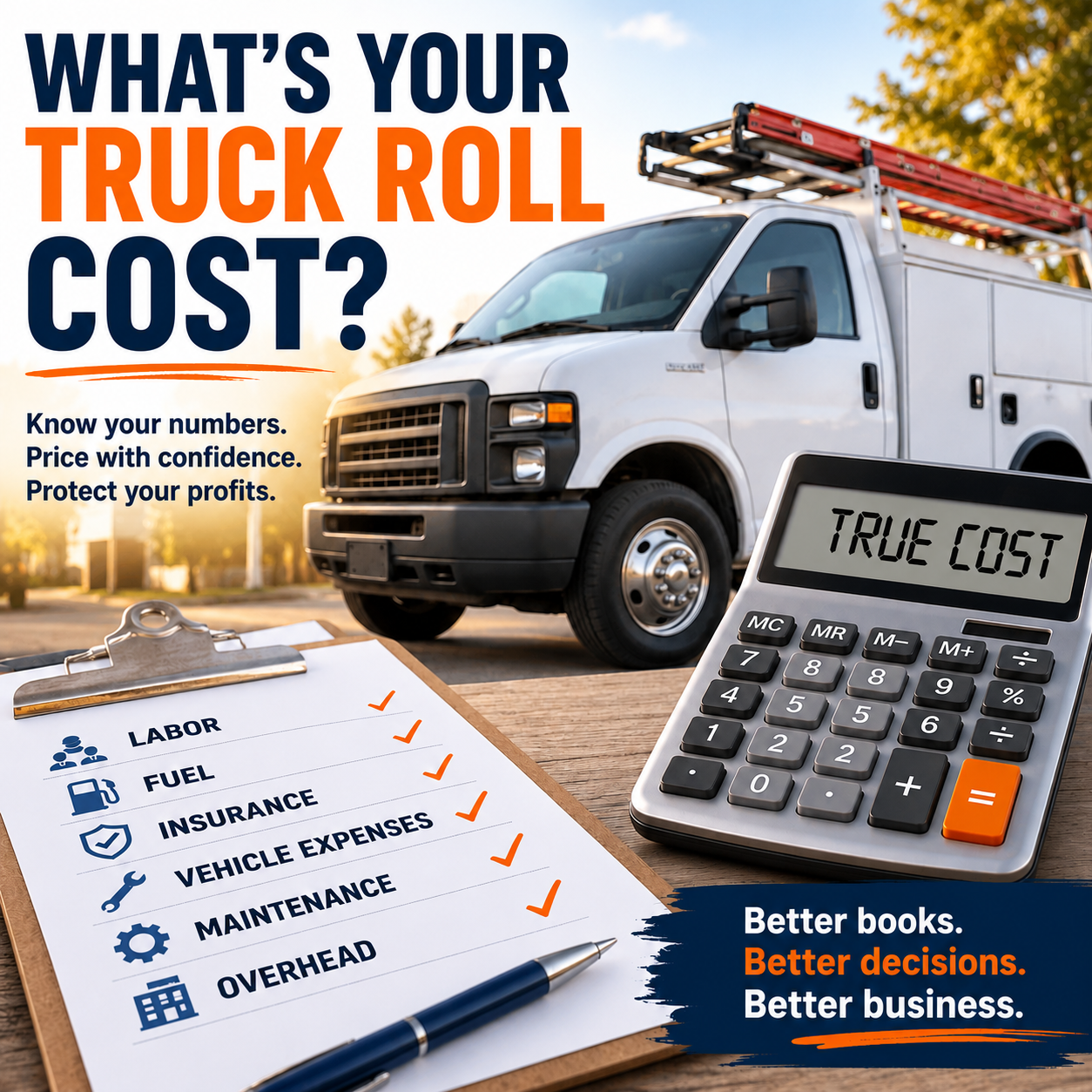
Are You Charging Enough? Calculate Your True Truck Roll Cost
For construction and field service business owners, the most expensive thing you can do is start an engine.
Whether you’re an HVAC contractor, a plumber, or a general contractor, every time a vehicle leaves your yard, you are spending money. In the industry, we call this a “Truck Roll.” If you aren’t accurately calculating your truck roll cost, you aren’t just guessing at your profitability—you might be paying for the privilege of working for your customers.
What Exactly is a Truck Roll?
A truck roll is the total cost of sending one technician in one vehicle to a job site. This includes the time spent driving, the fuel consumed, the wear and tear on the vehicle, and the administrative overhead required to get them there.
Why Most Business Owners Get the Math Wrong
Most owners look at their P&L and see "Fuel" or "Auto Insurance" as general overhead. To truly understand your margins, you need to view these as Direct Costs.
If you charge a $75 "service fee" to show up, but it costs you $120 just to get the truck into the customer's driveway, you are starting every single job at a $45 deficit.
The Step-by-Step Calculation
To find your true cost, look at your bookkeeping records from the last 12 months and aggregate the following three categories:
1. Vehicle Expenses
This is more than just gas. You must include:
Fuel & Fluids: Monthly average.
Maintenance: Tires, oil changes, and unexpected repairs.
Insurance: The commercial premiums for your fleet.
Lease/Loan Payments: Or, if you own the truck outright, the Depreciation (the loss in value over time).
2. Fully Burdened Labor
Don't just use the technician’s hourly rate. You must use the "Burdened Rate," which includes:
Base hourly pay.
Payroll taxes (FICA, SUTA, FUTA).
Workers' Compensation insurance.
Health benefits or 401k contributions.
The Travel Factor: Calculate the average time spent driving per day. If a tech spends 2 hours a day driving, that is 2 hours of "unapplied labor" that the truck roll must cover.
3. Dispatch & Admin Overhead
Every truck roll requires someone to take the call, schedule the job, and process the invoice. Divide your office staff salaries and software costs (like Jobber or ServiceTitan) by the number of jobs completed to find this per-job cost.
The Formula
Once you have your annual totals, use this simple formula:
(Total Annual Vehicle Costs + Annual Burdened Labor for Travel + Annual Dispatch Overhead) ÷ Total Number of Service Calls = Your Truck Roll Cost
Example:
Annual Vehicle Costs: $20,000
Travel Labor (2 hours/day x $40/hr x 250 days): $20,000
Dispatch Overhead: $10,000
Total Jobs Per Year: 400
Result: $50,000 ÷ 400 = $125 per Truck Roll
How to Lower Your Cost (and Boost Your Profit)
Once you know your number, you can take strategic action:
Route Optimization: If you can reduce average travel time by 15 minutes per job through better GPS routing, you could save thousands in labor costs annually.
Inventory Management: The "second trip" is a profit killer. If a technician has to leave a job to go to a supply house because they didn't have a $5 part on the truck, your truck roll cost for that job just doubled.
Adjust Your Minimums: If your truck roll cost is $125, but your "diagnostic fee" is only $89, it’s time to raise your prices. Your minimum fee should always cover the truck roll plus a small profit margin.
The Bookkeeper’s Perspective
Knowing your truck roll cost transforms your bookkeeping from a "historical record" into a "predictive tool." When you know exactly what it costs to move your fleet, you can bid on jobs with confidence, knowing exactly where your break-even point lies.
Need help digging into your COGS (Cost of Goods Sold) to find your true truck roll cost? Contact us today for a fleet-focused financial review.
Truck Roll Cost Calculator
Estimate what it really costs every time a truck leaves your yard.
Get a More In-Depth Look at My Books
Truck Roll Cost Worksheet
Estimate what it really costs every time a truck leaves your yard.
Your Numbers
Formula
(Vehicle Costs + Travel Labor + Dispatch/Admin) ÷ Total Calls
Quick Review
- Does your service fee cover your true cost?
- Are second trips reducing profit?
- Could routing reduce labor time?
- Are your costs clearly tracked?
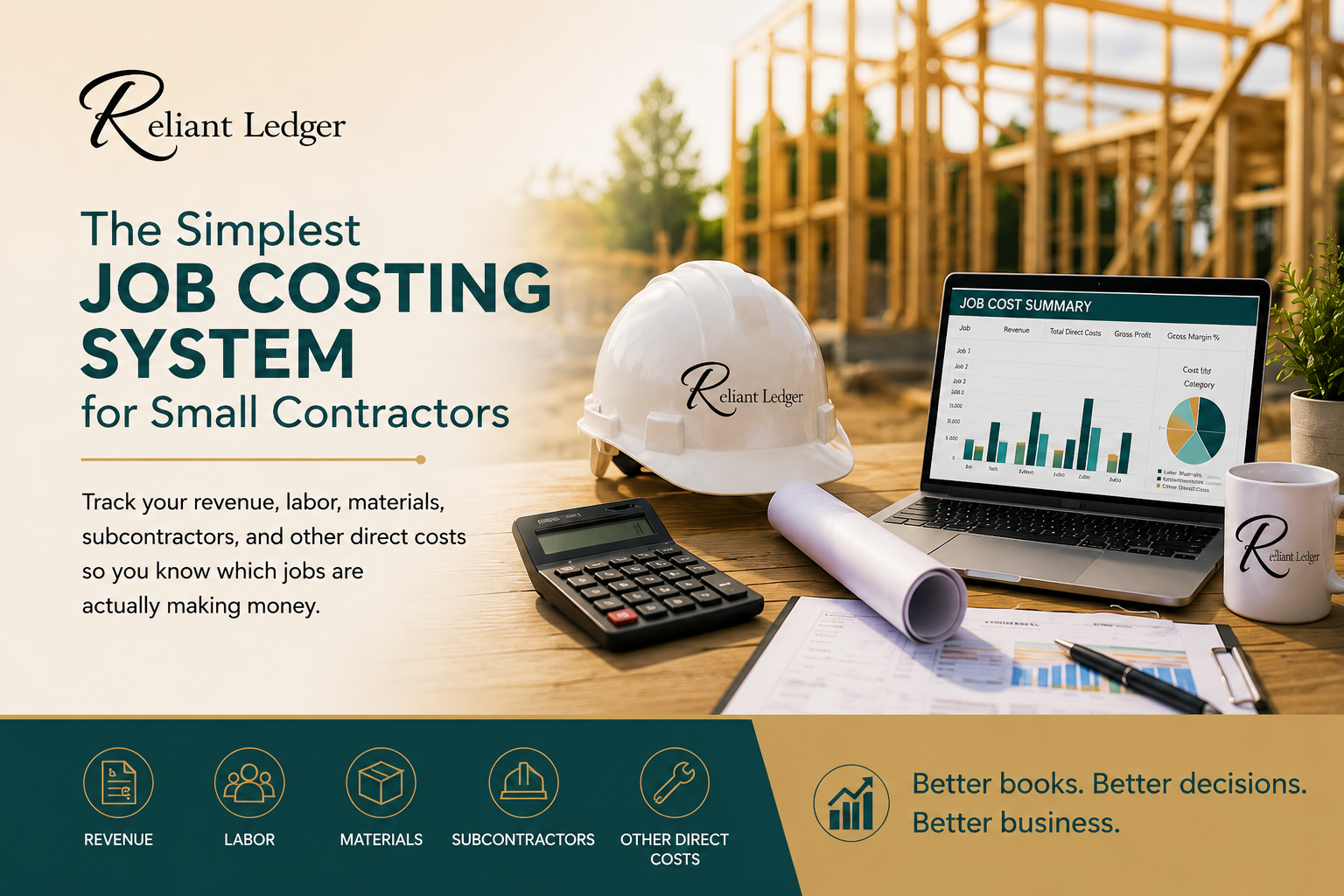
The Simplest Job Costing System for Small Contractors
Service Industry Insights
Many contractors know whether they are busy.
Far fewer know whether they are actually making money on each job.
At the end of the month, the bank account may be lower than expected. The schedule may be full, yet profits seem difficult to find.
The problem often comes down to one thing:
You can't improve what you don't measure.
That's where job costing comes in.
The good news is that job costing doesn't have to be complicated. You don't need expensive software or a full accounting department. A simple system can help you understand which jobs are profitable, which jobs need improvement, and whether your pricing is working.
What Is Job Costing?
Job costing is simply the process of tracking the income and expenses associated with a specific job or project.
For every job, you want to answer one question:
Did this job make money?
To answer that question, you need to compare:
Job Revenue
Labor Costs
Material Costs
Subcontractor Costs
Equipment and Other Direct Costs
The difference between your revenue and direct job costs is your gross profit for that job. Many contractors refer to this as "job profit," but gross profit is the accounting term you'll commonly see on financial reports.
Why Job Costing Matters
Without job costing, most contractors are forced to rely on guesswork.
You may know your company made money last month.
But do you know:
Which jobs were most profitable?
Which jobs lost money?
Whether your pricing is accurate?
Whether material costs are increasing?
Whether labor is taking longer than estimated?
Job costing provides answers.
It helps you make better decisions about pricing, estimating, staffing, and growth.
The Five Numbers Every Contractor Should Track
The simplest job costing system starts with five key categories.
1. Revenue
For a simple job costing system, start by tracking the amount billed (or earned) for the job. More advanced accounting methods may recognize revenue differently, but this approach works well for many small contractors.
Examples:
Service call invoice
Remodel contract
New installation project
Commercial maintenance agreement
Record the amount billed (or earned, depending on how you recognize revenue) for the job.
2. Labor
Labor is often one of the largest job costs.
Include:
Employee wages
Payroll taxes (when practical)
Labor hours worked
For a simple system, start by tracking employee wages and hours worked. As your business grows, consider including payroll taxes, workers' compensation, employee benefits, and other payroll costs to better reflect the true cost of labor.
Example:
Two technicians worked 8 hours each at $25 per hour.
16 hours × $25 = $400
3. Materials
Track materials used specifically for that job.
Examples:
Lumber
Pipe
Electrical supplies
HVAC equipment
Landscaping materials
Always assign material purchases to the appropriate job whenever possible. Materials purchased for general inventory should be assigned to the job when they are actually used, not simply when they are purchased.
4. Subcontractors
Examples:
Electrical subcontractor
Plumbing subcontractor
Drywall contractor
Concrete contractor
Track payments made to outside companies or individuals hired to complete work on a specific job.
5. Other Direct Costs
These are costs that can be traced directly to one specific job but don't fit into labor, materials, or subcontractors.
Examples include:
Equipment rental
Dumpster rental
Permit fees
Disposal fees
Job-specific fuel charges
Specialized tools rented for one project
If the expense exists because of that specific job, it belongs in direct job costs.
A Simple Job Costing Example
Let's say you complete a small HVAC installation.
Revenue:
$8,000
Labor:
$2,500
Materials:
$2,000
Equipment Rental:
$300
Total Direct Costs:
$4,800
Gross Profit:
$3,200
Gross Margin:
$3,200 ÷ $8,000 = 40%
Gross Profit = Revenue − Direct Job Costs
Gross Margin = Gross Profit ÷ Revenue
Gross profit tells you how many dollars the job generated before overhead expenses, while gross margin expresses that amount as a percentage of revenue.
This job generated a 40% gross margin before overhead expenses, meaning 40 cents of every dollar earned remained to cover overhead and contribute to net profit.
Now you have meaningful information you can compare to future jobs.
Don't Forget Overhead
One of the biggest mistakes contractors make is assuming gross profit equals company profit.
It doesn't.
Your business still has expenses that support every job.
Examples include:
Office rent
Insurance
Software subscriptions
Phones
Bookkeeping
Advertising
General vehicle expenses that cannot reasonably be assigned to a specific job
These costs are known as overhead.
A simple job costing system doesn't require you to allocate every overhead expense to every job.
However, you should understand that overhead must ultimately be covered by your gross profit.
This is one reason many contractors underprice their work without realizing it.
The Spreadsheet Method
Many small contractors can start with a simple spreadsheet.
Create columns for:
Job Name
Revenue
Labor Cost
Material Cost
Subcontractor Cost
Other Direct Costs
Total Direct Costs
Gross Profit
Gross Margin %
Update the spreadsheet as jobs are completed.
After several months, patterns begin to emerge.
You'll quickly see which jobs generate the strongest profits.
Reviewing Your Numbers
Job costing is only useful if you review it.
At least once per month, ask:
Which jobs were most profitable?
Which jobs had cost overruns?
Which jobs took longer than expected?
Are material costs increasing?
Are estimates accurate?
Small improvements in estimating, pricing, labor efficiency, or material purchasing can significantly improve profitability over time.
Common Job Costing Mistakes
Not Tracking Labor
Many contractors track materials but forget labor.
Labor is often one of the largest project costs.
Waiting Until Year-End
Job costing works best when reviewed regularly.
Waiting until tax season eliminates the opportunity to correct problems.
Ignoring Small Costs
Equipment rentals, permits, disposal fees, and other direct job costs all affect profitability. Even relatively small expenses can reduce the profit on a job if they aren't tracked.
General vehicle expenses that support the entire business are typically treated as overhead unless they can reasonably be assigned to a specific job.
Small costs add up quickly.
Looking Only at Revenue
Revenue is important.
Profitability is more important.
A $20,000 job with poor margins may contribute less profit than a $10,000 job with strong margins.
Start Simple
Many contractors avoid job costing because they believe it requires complicated software or advanced accounting knowledge.
It doesn't.
Start with five categories:
Revenue
Labor
Materials
Subcontractors
Other Direct Costs
Track them consistently.
Review them monthly.
Look for trends.
As your business grows, your system can become more sophisticated.
But even a simple job costing system is far better than no system at all.
Remember that job costing is a management tool—not just an accounting exercise. The goal isn't to create perfect reports. The goal is to understand which jobs are making money so you can make better pricing, estimating, and scheduling decisions.
Ready to Start Tracking Job Profitability?
You've learned the basics of job costing—now put them into practice.
Download the Free Excel Job Costing Spreadsheet created for small contractors and field service businesses. It's the same simple system described in this article and is designed to help you understand which jobs are actually making money.
The Bottom Line
Job costing helps contractors understand where their profits come from and where they disappear.
You don't need complicated reports or expensive software to get started.
A simple system that tracks revenue, labor, materials, subcontractors, and other direct job costs can provide valuable insight into your business.
The contractors who consistently measure their job costs are better equipped to price future work accurately, protect their profit margins, and build stronger businesses over time. After all, you can't improve what you don't measure.
Better books. Better decisions. Better business.
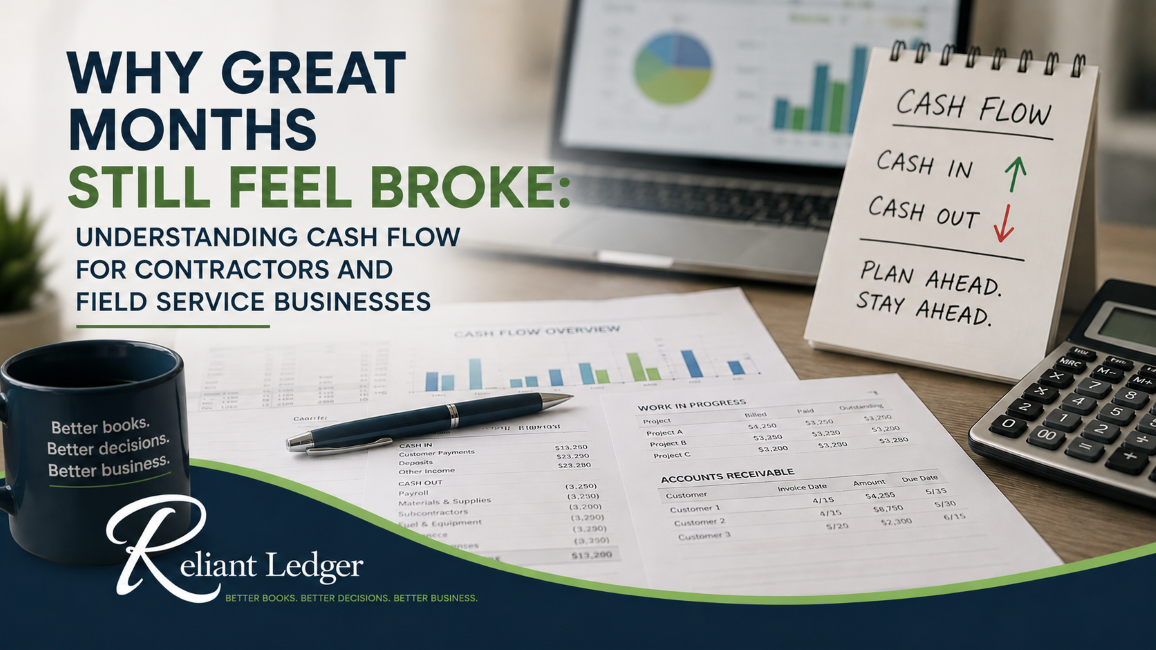
Why Great Months Still Feel Broke: Understanding Cash Flow for Contractors and Field Service Businesses
A full schedule doesn't always mean healthy finances. Discover why contractors and field service businesses can be profitable on paper yet struggle with cash flow—and what to do about it.
Service Industry Insights
Have you ever looked at your schedule and thought:
"We've been busy all month. Why does it still feel like there's never enough cash in the bank?"
If you're a contractor or field service business owner, you're not alone.
Many business owners assume that a full schedule automatically means healthy finances. Unfortunately, that's not always true. A company can have strong sales, a full pipeline of work, and still struggle to pay bills on time.
The reason often comes down to one critical concept: cash flow.
Understanding cash flow can help you reduce financial stress, make better decisions, and build a stronger business.
What Is Cash Flow?
Simply put, cash flow is the movement of money into and out of your business. Positive cash flow means that over a given period, more cash is coming into the business than leaving it. Negative cash flow means expenses are leaving your business faster than payments are arriving.
For contractors and field service businesses, cash flow can be especially challenging because expenses often occur long before customer payments arrive.
You may need to pay for:
Materials
Labor
Fuel
Equipment
Insurance
Subcontractors
Weeks before receiving payment from the customer.
Revenue Doesn't Equal Cash
One of the most common bookkeeping misunderstandings is assuming revenue equals cash.
The timing between completing work and receiving payment can vary significantly depending on your business model.
A field service company may complete a job and invoice the same day.
A contractor may operate on deposits, progress billing, milestone payments, or retainage agreements.
Regardless of the billing method, cash flow challenges arise whenever expenses leave the business faster than payments arrive.
This is why profitable businesses can still experience cash shortages.
Profit and Cash Flow Are Not the Same Thing
One of the most important financial concepts for business owners to understand is the difference between profit and cash flow.
Profit measures whether your revenue exceeds your expenses.
Cash flow measures whether cash is available when bills come due.
A business can be profitable on paper while still struggling to meet payroll, purchase materials, or pay vendors if customer payments have not yet been collected.
Understanding both profit and cash flow helps business owners make more informed financial decisions.
The Three Biggest Cash Flow Killers
1. Delays Between Work and Payment
One of the biggest challenges for both contractors and field service businesses is the time between completing work and receiving payment.
For field service companies, delays often occur when invoices are not sent promptly after a job is completed. Contractors face a different challenge, managing deposits, progress billing, retainage, and collection timelines throughout a project.
Regardless of the billing method, the longer cash is tied up, the greater the strain on working capital. Field service businesses can often improve cash flow by making invoicing part of the job completion process—a concept I discuss in The Driveway Rule: The Ultimate Cash Flow Hack. Contractors can achieve similar results through clear payment terms, timely progress billing, and proactive collection practices.
2. Slow Customer Payments
Even when invoices are sent promptly or billing milestones are met, some customers take longer to pay than expected.
Contractors often experience payment delays due to:
Approval processes
Progress billing schedules
Retainage
Administrative delays
Field service businesses may face delays when customers overlook invoices or postpone payment.
The longer payments are delayed, the more pressure is placed on working capital.
3. Unexpected Expenses
Every contractor and service business owner has experienced surprise costs:
Equipment repairs
Vehicle maintenance
Material price increases
Project delays
Weather-related disruptions
Without adequate cash reserves, even a profitable month can become financially stressful.
Why Strong Sales Don't Always Mean Healthy Cash Flow
Sales measure activity. Cash flow measures liquidity.
A business can have strong sales and still experience financial stress if customer payments are delayed or expenses exceed available cash.
Healthy cash flow allows you to:
Pay employees on time
Purchase materials when needed
Take advantage of growth opportunities
Reduce reliance on credit
Maintain greater financial stability and confidence
Businesses that actively manage cash flow are generally better positioned to handle slow periods and unexpected challenges.
Five Practical Ways to Improve Cash Flow
1. Reduce the Time Between Work and Payment
Field service businesses may benefit from invoicing immediately after completing a job.
Contractors may improve cash flow by using deposits, progress billing, milestone payments, and clearly defined payment terms.
The goal is to reduce unnecessary delays between performing the work and receiving payment.
2. Collect Deposits When Appropriate
For larger projects, upfront deposits can help cover material costs and reduce financial risk.
Clear payment schedules can also improve predictability and help maintain healthy working capital throughout a project.
3. Forecast Cash Flow
Spend a few minutes each week reviewing:
Upcoming payroll
Vendor payments
Expected customer payments
Regular forecasting can help identify potential shortages before they become emergencies.
4. Build a Cash Reserve
Building a cash reserve—even one month's worth of operating expenses—can help provide additional stability during slower periods or unexpected disruptions.
While every business is different, having cash set aside can reduce stress and provide flexibility when challenges arise.
5. Review Job Profitability
Cash flow problems are sometimes profitability problems in disguise.
If jobs are not generating enough profit, cash flow will eventually suffer.
Understanding labor costs, material costs, overhead expenses, and pricing helps ensure that your work contributes to both profitability and healthy cash flow.
The Connection Between Cash Flow and Recurring Revenue
One reason many successful service businesses invest in maintenance agreements and service plans is predictability.
Recurring revenue creates more consistent cash inflows, making it easier to manage expenses and forecast future cash needs.
If you haven't already, I encourage you to read The Field Service Guide to Predictable Recurring Revenue to learn how recurring income can help smooth out the feast-or-famine cycle many service businesses experience.
The Bottom Line
Being busy doesn't automatically mean your cash flow is healthy.
Cash flow improves when you:
Reduce delays between work and payment
Monitor receivables
Forecast regularly
Maintain cash reserves
Understand your numbers
A full schedule is important.
Getting paid for that work in a timely manner—and maintaining sufficient cash to operate your business—is what keeps your company moving forward.
Ready for Better Visibility Into Your Numbers?
At Reliant Ledger, I help contractors and field service businesses maintain clean books, understand their cash flow, and make confident financial decisions.
Better books. Better decisions. Better business.

Starting a New Career After 60: The Reliant Ledger Story
You made it to retirement! But if you're like me, you aren't quite ready for the rocking chair—unless it’s on a porch overlooking a garden and a flock of happy chickens. My "second act" is about finally pursuing the dreams I once put on hold: building a homestead and running my own business. I launched my bookkeeping practice to support my life on the farm, proving that you can have both a professional mindset and a pair of muddy boots.
Why Start Now?
After 60 is a fantastic time to launch a business. With the stability of retirement income to lean on while you grow, the pressure is off, and the focus is on quality. The skills acquired from 40-plus years of working are unprecedented.
You made it to retirement! But if you're like me, you aren't quite ready for the rocking chair—unless it’s on a porch overlooking a garden and a flock of happy chickens. My "second act" is about finally pursuing the dreams I once put on hold: building a homestead and running Reliant Ledger. I launched my practice to support my life on the farm, proving that you can have both a professional mindset and a pair of muddy boots.
Why Start Now?
After 60 is a fantastic time to launch a business. With the stability of retirement income to lean on while you grow, the pressure is off, and the focus is on quality. The skills acquired from 40-plus years of working are unprecedented. My background—spanning the accounting department of a manufacturing company, serving as the bookkeeper for a start-up, and 19 years as a Court Clerk—has forged a level of professional ethics and a "cool head."
That experience is exactly what’s needed when a client is overwhelmed and needs a thorough cleanup process for their books. I’ve seen it all, and I know how to turn chaos into clarity.
Reclaim Your Time and Your Peace of Mind
You didn’t start your business to spend your weekends wrestling with spreadsheets. My goal is to lift the weight of financial tracking off your shoulders so you can get back to the work you actually enjoy.
When you partner with Reliant Ledger, you gain access to:
A Fresh Start with Catch-up Bookkeeping: Whether you’re months or even years behind, I specialize in bringing your records current. I’ll bridge the gap quickly, giving you a clean slate and a clear path forward.
Precision Through Account Restoration: Your books should be a reliable tool, not a source of stress. I’ll untangle messy records and reconcile your accounts, delivering the accurate financial statements you need to lead with confidence.
Confidence in Your Cash Flow: Small business income can be unpredictable. I help you master the "peaks and valleys" of your revenue so you can plan for growth and never feel blindsided by a lean month again.
Ready to get your books on track?
Whether you are a fellow entrepreneur starting your second act or a busy contractor focused on your craft, I’d love to help you clear the paperwork off your desk. Reliant Ledger is here to save you time and give you the peace of mind to focus on what you love.
[Click here to schedule a free 30-minute consultation, and let’s get your books on track.]
About Reliant Ledger Providing professional catch-up bookkeeping and virtual bookkeeping services for small businesses and contractors. Proudly serving as a trusted bookkeeper in Towanda, KS, and supporting clients throughout the Wichita area and El Dorado.