
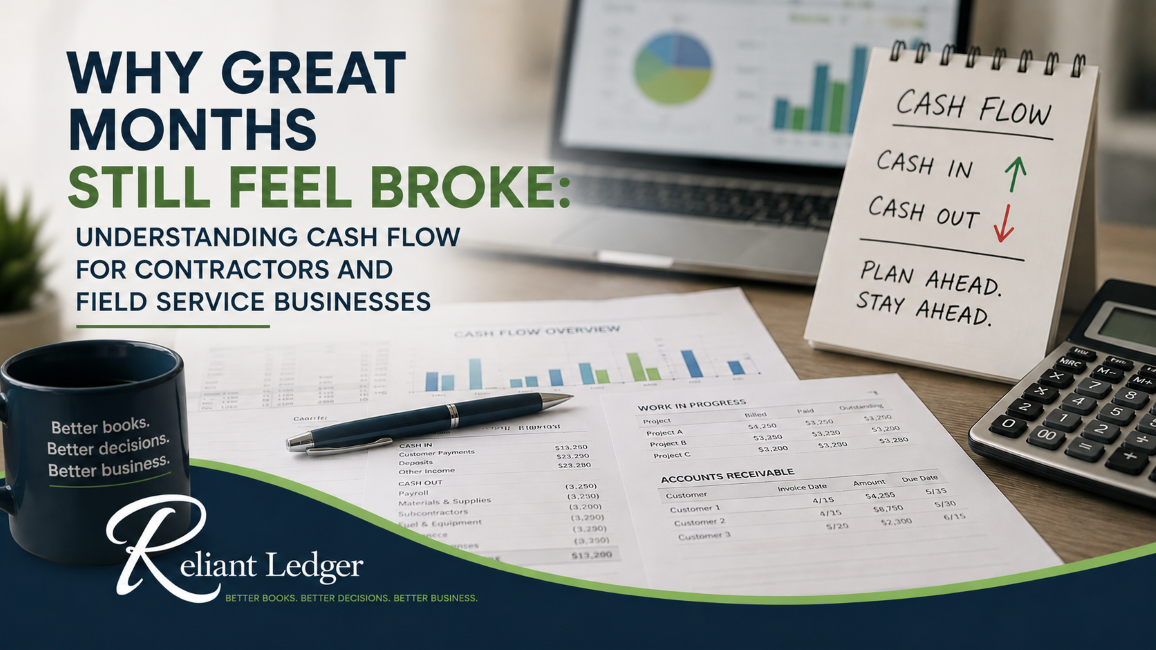
Why Great Months Still Feel Broke: Understanding Cash Flow for Contractors and Field Service Businesses
A full schedule doesn't always mean healthy finances. Discover why contractors and field service businesses can be profitable on paper yet struggle with cash flow—and what to do about it.
Service Industry Insights
Have you ever looked at your schedule and thought:
"We've been busy all month. Why does it still feel like there's never enough cash in the bank?"
If you're a contractor or field service business owner, you're not alone.
Many business owners assume that a full schedule automatically means healthy finances. Unfortunately, that's not always true. A company can have strong sales, a full pipeline of work, and still struggle to pay bills on time.
The reason often comes down to one critical concept: cash flow.
Understanding cash flow can help you reduce financial stress, make better decisions, and build a stronger business.
What Is Cash Flow?
Simply put, cash flow is the movement of money into and out of your business. Positive cash flow means that over a given period, more cash is coming into the business than leaving it. Negative cash flow means expenses are leaving your business faster than payments are arriving.
For contractors and field service businesses, cash flow can be especially challenging because expenses often occur long before customer payments arrive.
You may need to pay for:
Materials
Labor
Fuel
Equipment
Insurance
Subcontractors
Weeks before receiving payment from the customer.
Revenue Doesn't Equal Cash
One of the most common bookkeeping misunderstandings is assuming revenue equals cash.
The timing between completing work and receiving payment can vary significantly depending on your business model.
A field service company may complete a job and invoice the same day.
A contractor may operate on deposits, progress billing, milestone payments, or retainage agreements.
Regardless of the billing method, cash flow challenges arise whenever expenses leave the business faster than payments arrive.
This is why profitable businesses can still experience cash shortages.
Profit and Cash Flow Are Not the Same Thing
One of the most important financial concepts for business owners to understand is the difference between profit and cash flow.
Profit measures whether your revenue exceeds your expenses.
Cash flow measures whether cash is available when bills come due.
A business can be profitable on paper while still struggling to meet payroll, purchase materials, or pay vendors if customer payments have not yet been collected.
Understanding both profit and cash flow helps business owners make more informed financial decisions.
The Three Biggest Cash Flow Killers
1. Delays Between Work and Payment
One of the biggest challenges for both contractors and field service businesses is the time between completing work and receiving payment.
For field service companies, delays often occur when invoices are not sent promptly after a job is completed. Contractors face a different challenge, managing deposits, progress billing, retainage, and collection timelines throughout a project.
Regardless of the billing method, the longer cash is tied up, the greater the strain on working capital. Field service businesses can often improve cash flow by making invoicing part of the job completion process—a concept I discuss in The Driveway Rule: The Ultimate Cash Flow Hack. Contractors can achieve similar results through clear payment terms, timely progress billing, and proactive collection practices.
2. Slow Customer Payments
Even when invoices are sent promptly or billing milestones are met, some customers take longer to pay than expected.
Contractors often experience payment delays due to:
Approval processes
Progress billing schedules
Retainage
Administrative delays
Field service businesses may face delays when customers overlook invoices or postpone payment.
The longer payments are delayed, the more pressure is placed on working capital.
3. Unexpected Expenses
Every contractor and service business owner has experienced surprise costs:
Equipment repairs
Vehicle maintenance
Material price increases
Project delays
Weather-related disruptions
Without adequate cash reserves, even a profitable month can become financially stressful.
Why Strong Sales Don't Always Mean Healthy Cash Flow
Sales measure activity. Cash flow measures liquidity.
A business can have strong sales and still experience financial stress if customer payments are delayed or expenses exceed available cash.
Healthy cash flow allows you to:
Pay employees on time
Purchase materials when needed
Take advantage of growth opportunities
Reduce reliance on credit
Maintain greater financial stability and confidence
Businesses that actively manage cash flow are generally better positioned to handle slow periods and unexpected challenges.
Five Practical Ways to Improve Cash Flow
1. Reduce the Time Between Work and Payment
Field service businesses may benefit from invoicing immediately after completing a job.
Contractors may improve cash flow by using deposits, progress billing, milestone payments, and clearly defined payment terms.
The goal is to reduce unnecessary delays between performing the work and receiving payment.
2. Collect Deposits When Appropriate
For larger projects, upfront deposits can help cover material costs and reduce financial risk.
Clear payment schedules can also improve predictability and help maintain healthy working capital throughout a project.
3. Forecast Cash Flow
Spend a few minutes each week reviewing:
Upcoming payroll
Vendor payments
Expected customer payments
Regular forecasting can help identify potential shortages before they become emergencies.
4. Build a Cash Reserve
Building a cash reserve—even one month's worth of operating expenses—can help provide additional stability during slower periods or unexpected disruptions.
While every business is different, having cash set aside can reduce stress and provide flexibility when challenges arise.
5. Review Job Profitability
Cash flow problems are sometimes profitability problems in disguise.
If jobs are not generating enough profit, cash flow will eventually suffer.
Understanding labor costs, material costs, overhead expenses, and pricing helps ensure that your work contributes to both profitability and healthy cash flow.
The Connection Between Cash Flow and Recurring Revenue
One reason many successful service businesses invest in maintenance agreements and service plans is predictability.
Recurring revenue creates more consistent cash inflows, making it easier to manage expenses and forecast future cash needs.
If you haven't already, I encourage you to read The Field Service Guide to Predictable Recurring Revenue to learn how recurring income can help smooth out the feast-or-famine cycle many service businesses experience.
The Bottom Line
Being busy doesn't automatically mean your cash flow is healthy.
Cash flow improves when you:
Reduce delays between work and payment
Monitor receivables
Forecast regularly
Maintain cash reserves
Understand your numbers
A full schedule is important.
Getting paid for that work in a timely manner—and maintaining sufficient cash to operate your business—is what keeps your company moving forward.
Ready for Better Visibility Into Your Numbers?
At Reliant Ledger, I help contractors and field service businesses maintain clean books, understand their cash flow, and make confident financial decisions.
Better books. Better decisions. Better business.