
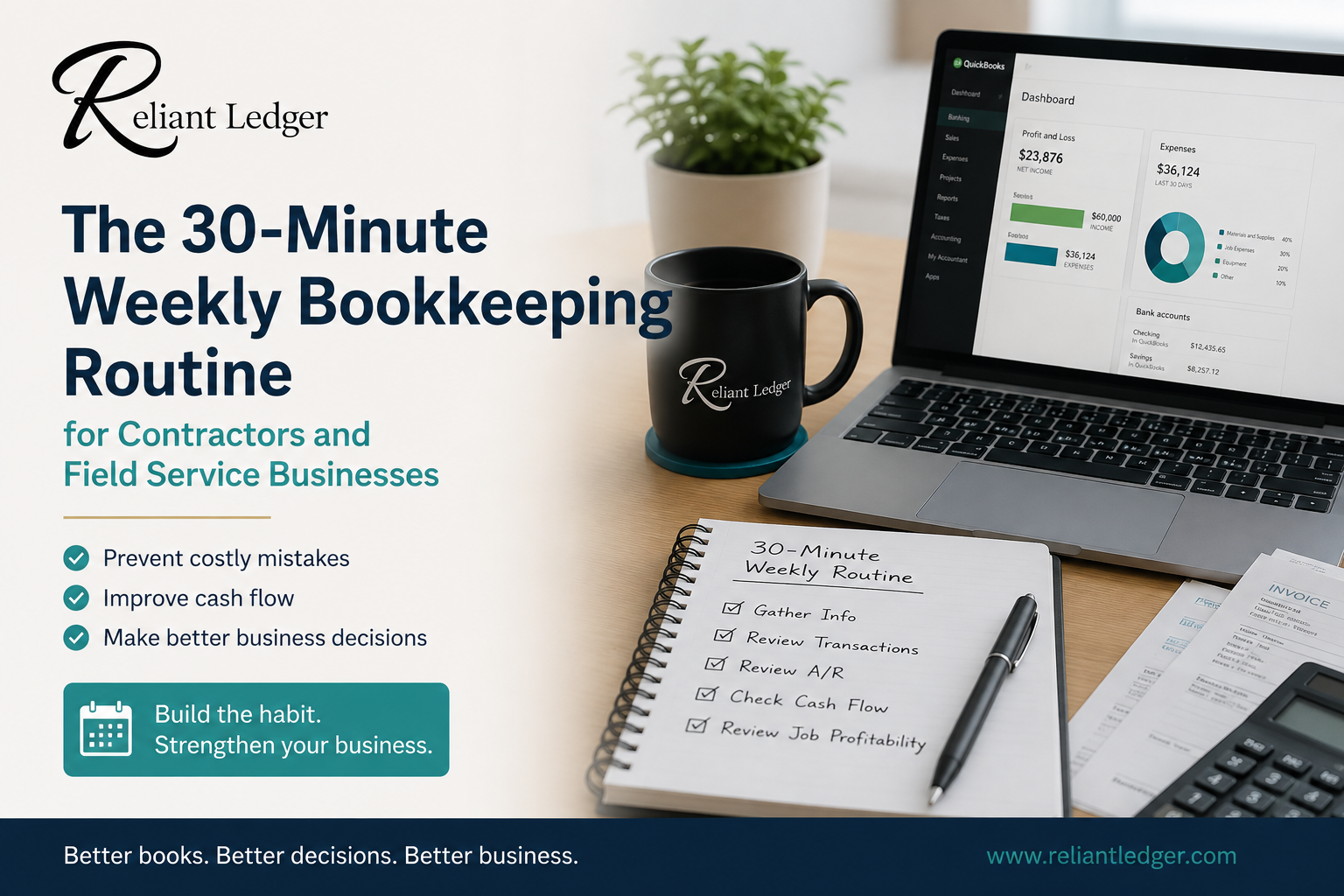
The 30-Minute Weekly Bookkeeping Routine for Contractors and Field Service Businesses
Learn a simple 30-minute weekly bookkeeping routine designed for contractors and field service businesses. Improve cash flow, stay tax-ready, and keep your books organized with easy weekly habits.
Service Industry Insights
For many contractors and field service business owners, bookkeeping tends to fall into one of two categories:
It gets done at tax time.
It gets done when there's a problem.
Neither approach works very well.
When bookkeeping gets pushed aside for months, it becomes overwhelming. Receipts pile up. Transactions go uncategorized. Bank balances become questionable. Tax season becomes stressful.
The good news is that maintaining clean books doesn't require hours every week.
In fact, many small business owners can stay on top of their finances with a simple 30-minute weekly bookkeeping routine.
A little consistency each week can prevent major cleanup projects later.
Why Weekly Is Better Than Monthly
Many business owners wait until the end of the month to review their finances.
The problem is that by then:
Missing receipts are harder to find
Billing delays have already impacted cash flow
Bank errors may go unnoticed
Customer payments may already be overdue
A weekly routine keeps small issues from becoming large problems.
Think of it like preventative maintenance for your business finances.
The First 5 Minutes: Gather Your Financial Information
Start by collecting:
Bank account information
Credit card transactions
Receipts
Vendor invoices
Customer payments received
If you're using QuickBooks Online, much of this information may already be imported through bank feeds.
The goal is simply to make sure everything is available before you begin.
The Next 10 Minutes: Review and Categorize Transactions
Now review the week's activity.
Ask:
Is every transaction categorized correctly?
Were any personal expenses accidentally charged to the business?
Are all customer payments recorded?
Are there any duplicate transactions?
This step helps ensure your Profit & Loss report remains accurate throughout the year.
Small mistakes are easy to fix now.
They're much harder to fix six months from now.
The Next 5 Minutes: Review Accounts Receivable
Money owed to your business deserves attention every week.
Review:
Outstanding invoices
Overdue balances
Recent customer payments
Ask yourself:
Has every completed job been invoiced?
Are any invoices becoming overdue?
Do customers need payment reminders?
One of the easiest ways to improve cash flow is simply following up on unpaid invoices consistently.
The Next 5 Minutes: Check Cash Flow
You don't need a complicated forecast.
Simply review:
Current bank balance
Upcoming payroll
Vendor payments due
Large expenses expected soon
This quick review can help identify cash shortages before they become emergencies.
Many business owners discover that a 5-minute review saves hours of financial stress later.
The Final 5 Minutes: Review Job Profitability
If you're tracking jobs, spend a few minutes reviewing:
Labor costs
Material costs
Subcontractor expenses
Progress toward completion
Ask:
Are jobs staying within budget?
Are any projects losing money?
Do pricing adjustments need to be made?
The sooner you identify profitability problems, the easier they are to correct.
What Happens When You Skip This Routine?
When bookkeeping gets postponed:
Invoices go unsent
Customer payments slow down
Receipts disappear
Tax preparation becomes stressful
Financial reports become unreliable
Many bookkeeping cleanup projects begin with a simple problem:
"I got busy and stopped looking at my books."
A Weekly Habit That Builds Better Businesses
Successful contractors don't necessarily spend more time on bookkeeping.
They spend time consistently.
Thirty minutes each week can help you:
Maintain clean books
Improve cash flow
Stay tax-ready
Understand profitability
Make better business decisions
Consistency beats catch-up every time.
The Bottom Line
Bookkeeping doesn't have to take over your life.
A simple 30-minute weekly routine can help you stay organized, reduce financial stress, and maintain better visibility into your business.
Small habits create big results.
Better books. Better decisions. Better business.
Beyond the Numbers: The Essential Qualities of a Professional Bookkeeper
In the world of business, your financial records are the heartbeat of your operations. While many business owners attempt to manage their own ledgers, there comes a point where DIY spreadsheets are no longer enough. When you look for a bookkeeping service, you aren’t just hiring someone to crunch numbers—you are hiring a guardian for your business’s financial health.
According to the U.S. Bureau of Labor Statistics, the core duties of a bookkeeper involve recording financial transactions, updating statements, and checking financial records for accuracy. But what separates a standard data-entry clerk from a top-tier professional?
Here are the high-level qualities you should look for in a professional bookkeeper.
1. Unwavering Integrity and Confidentiality
A bookkeeper has a front-row seat to your company’s most sensitive information—from payroll data to profit margins. Confidentiality isn't just a preference; it’s a requirement. A high-quality professional maintains strict security protocols to ensure your data is protected from external threats. You need to know that your financial "open book" is being handled with the highest level of integrity.
2. Meticulous Accuracy
The difference between a thriving business and a legal or tax headache often comes down to a single decimal point. A great bookkeeper doesn't just "input" data; they audit it as they go. By constantly checking financial records for accuracy, they ensure that your reports reflect reality, allowing you to make informed decisions based on solid data.
3. Technical Expertise (The QuickBooks ProAdvisor Advantage)
In the modern era, a bookkeeper must be tech-savvy. You should look for a professional who is a QuickBooks ProAdvisor. This certification means they have a deep, verified understanding of the industry's leading software. They don't just use the tools; they optimize them to automate your workflows, manage your accounts payable and receivable, and provide cleaner reporting.
4. Organization and Consistency
Financial transactions don't take a day off. A professional bookkeeper excels at staying organized under the pressure of deadlines—whether it’s monthly closings or preparing for tax season. Their ability to maintain a consistent rhythm ensures that your financial statements are always up to date, rather than a backlog of receipts waiting to be tackled.
Take Control of Your Financial Future
Don't let disorganized books hold your business back from its full potential. Reliant Ledger combines the technical skill of a QuickBooks ProAdvisor with the integrity and accuracy your business deserves.
Contact us today for a free consultation and see how we can streamline your financial records for a more profitable tomorrow!